Getting the transcript
Reading the captions from YouTube. A video nobody has opened here before takes 10 to 30 seconds; this page fills in on its own.
Reading the captions from YouTube. A video nobody has opened here before takes 10 to 30 seconds; this page fills in on its own.
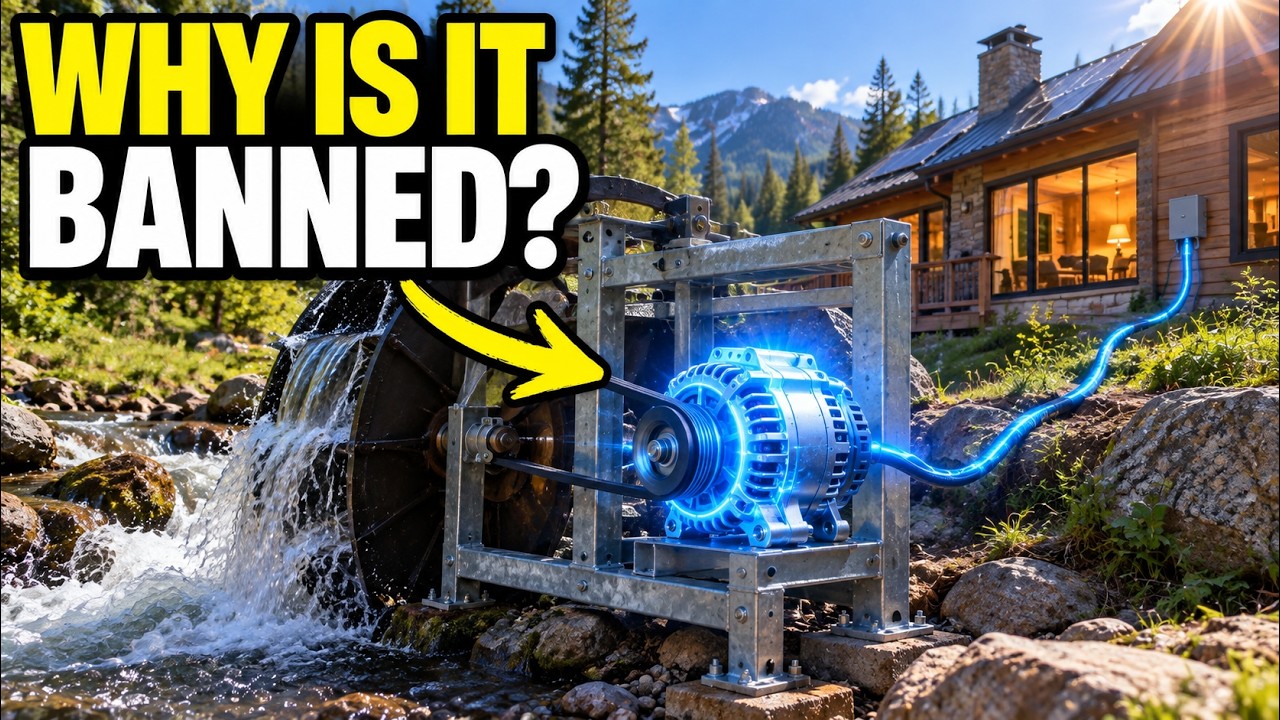
The Passive House Files · @griffithselijah7018
This video has no Most replayed graph yet: YouTube shows one only once a video has enough views. These are the moments viewers replayed most in The Passive House Files's most watched videos.
Most replayed moment at 18:23
6.0x that video's typical replay level
current US retail prices. Dig 10 holes in moist ground spaced about 12 in apart. In each hole, push one copper section and one galvanized nail about 6 to 8 in deep, keeping the two electrodes 3 to 4
Said at 18:17
The graph counts replays. It does not show where viewers stopped watching.
Words
5,034
Runtime
32:25
Speaking pace
155wpm
Reading time
21min
155 words per minute, below the 160 25th percentile of 349 measured videos. That distribution comes from the 349-video hook study.
Opening (first 30 seconds)
In 1943, a high desert ranch hand named Earl Whitmore pulled a $12 Delco Remy alternator from a scrapped 1938 Chevrolet truck, bolted it to a paddle wheel he built from fence lumber in a creek bed on his cattle lease in Harney County, Oregon, and spent the next 27 years lighting a line cabin 14 mi from the nearest power line without ever paying a single scent to an electric company. His foreman thought he was wasting
78 words, the words spoken in the first 30 seconds at 155 words per minute.
Free, no signup. See how the first 30 seconds hold attention, with rewrites.
Sentence shape
What this transcript is
Every word below is the caption track YouTube publishes for this video, pulled from the video itself and reproduced unchanged. It is not Prepublish's writing, not a summary, and not a re-transcription: it is the video's own published captions. English captions, generated automatically by YouTube, in the video’s original language. Source: the video on YouTube. A channel that would rather this page did not exist can ask for its removal through the contact page, and it is removed.
In 1943, a high desert ranch hand named Earl Whitmore pulled a $12 Delco Remy alternator from a scrapped 1938 Chevrolet truck, bolted it to a paddle wheel he built from fence lumber in a creek bed on his cattle lease in Harney County, Oregon, and spent the next 27 years lighting a line cabin 14 mi from the nearest power line without ever paying a single scent to an electric company. His foreman thought he was wasting time.
His grandsons thought he was ahead of it. The Bureau of Land Management, when they finally surveyed that parcel in 1971, recorded a functioning 12volt lighting circuit and an electric fence charger still running off the same creek-driven alternator. No grid connection, no portable generator, no gasoline delivery, no monthly bill from any utility of any kind. Just a junkyard car part, a wooden wheel in a stream, and a principle of electrical generation so simple that the modern portable generator industry has spent 60 years pretending it does not exist.
Because if you understood what Earl Witmore understood, you would never spend another $4,000 on a machine designed to break in 8 years for as long as you live. And that is exactly what off-grid ranchers in Harney County, in Aahhei County, in the Bitterroot in the Missouri brakes, and every backcountry line camp from Oregon to Montana have been quietly doing for over 80 years. They call it the alternator build. If you built the same alternator rig behind your cabin this Saturday, you would have a working power source that runs your lights, your refrigerator, and your well pump for as long as the creek flows or the engine turns. and you would never hand another $4,000 to Honda or GenerRack for a plastic box full of circuit boards engineered to fail 2 months past the warranty.
You are looking at $60 for the alternator at any auto parts counter and maybe another 40 in belts, pulleys, and wire. $100 total. The portable generator industry did $9.8 billion in revenue in the United States last year. That is not a typo. 9.8 billion. And every dollar of that number depends on you believing that generating electricity requires a purpose-built machine with a proprietary control board and a dealer network.
That industry has a very strong financial interest in making sure you never find out that the part doing all the work inside their machine costs less than a tank of gas. Let me show you why this works, why it has always worked, and why almost nobody in the generator industry will ever mention it to you. The science behind this is so simple it almost feels like cheating. You could explain it to a 12-year-old with a magnet and a spool of copper wire, and that kid would understand it faster than most electrical engineering students because he has not been taught to over complicated yet.
Here is what an alternator does. Inside the housing, there is a rotor that is just an electromagnet that spins. Around that rotor, there is a stator that is just a ring of copper wire coils that sit still. When the rotor spins inside the stator, the moving magnetic field pushes electrons through the copper. That is electricity. That is all electricity has ever been. Michael Faraday figured this out in 1831 with a copper disc and a horseshoe magnet in a London basement.
And the principle has not changed by a single word in 193 years. Spin a magnet near a wire, current flows. Stop spinning, current stops. There is no step three. Now, the alternator adds one small piece that makes it practical. The raw output of those spinning coils is alternating current. Your battery needs direct current. So, every alternator built since the early 1960s has a diode rectifier bridge bolted inside the back housing.
Six dodes. They convert the AC to DC before it ever leaves the unit. The moment you spin an alternator at the right speed, you get clean 12 to 14 volt direct current out of the back terminal, ready to charge a battery. No external conversion needed. The voltage regulator that controls rotor magnet strength is also already inside most modern units. You are not building a charging system. You are uncovering one that General Motors already engineered for you and sold to AutoZone for $60.
The numbers tell you everything you need to know about why this matters for your cabin. A common 160 amp alternator spinning at 3000 RPM produces right around 14 volts at full output. Multiply 14 volt by 160 amps and you get over 2,000 W of continuous power. Your cabin probably needs a fraction of that. LED lighting for three rooms runs about 60 W. A standard chest freezer pulls 150 watts. A half horsepower well pump draws 500 watts, but only cycles on for a few minutes at a time.
A phone charger and a weather radio together add maybe 25 watts. Your peak demand on a busy evening hits roughly 735 watts. That alternator gives you three times what you need. The Department of Energy published a technical brief in 2004 called Fundamentals of Smallscale Power Generation. A title so boring you could use it to put an insomniac to sleep. Buried on page 14 is a table comparing the watts per dollar of various generation methods.
The automotive alternator falls in the same output range as commercial generators costing $800 to $2,000 at retail. The brief notes that core electromagnetic conversion efficiency of a permanent magnet alternator runs between 50 and 70% at rated speed. That is the same efficiency range as the generator sitting on the shelf at your Home Depot right now with a price tag 40 times higher. And if you think this is some fringe theory that only works on paper, you should know that people have been proving it works with their hands for the better part of a century.
Start in the southern Appalachian Mountains in the 1930s when the Tennessee Valley Authority was still stringing wire across the lowlands. Entire hollows in western North Carolina and North Georgia had not been reached yet. Families in those hollows needed light. They needed a way to charge a fence charger, run a radio, maybe power a small milk cooler. And what they had was creeks. fast, cold, year round creeks running off granite ridge lines with enough drop to spin a wheel.
So, they pulled the generator unit out of a junked Ford or Chevrolet, mounted it to a homemade water wheel, [music] and ran wire to the house. These were not engineers. These were tobacco farmers and sawmill hands who understood that a spinning magnet makes current and a creek never stops spinning. That is not folklore. It was documented. In 1979, a team at the Foxfire Fund in Raben County, Georgia, published volume five of the Foxfire book series.
That book contains detailed interviews, photographs, and handdrawn diagrams of water powered car generator setups that mountain families had been running for decades. The Foxfire team recorded output figures, sketched pulley arrangements, and noted that several rigs had been in continuous operation since the late 1930s. 40 years of service from a car part that cost a few dollars at a junkyard. You can still buy that book today for $11 on Amazon.
And the diagrams are clear enough to build from this weekend. Now, fast forward to the 1950s because this is where it gets interesting for your wallet. After the Korean War, the military had warehouses full of surplus portable generating equipment. Most of those units were not exotic technology. They were alternators bolted to small gasoline engines, mounted on a steel frame, painted olive drab, and shipped to field camps to charge radio batteries.
Sears Robbuk listed surplus military generators in their catalog from 1955 through 1968. You could buy one for $30 to $50 delivered to your door. The Sears copy called it a portable power plant, but if you pulled the housing off, that is exactly what you found inside. An alternator, a small engine, a belt. [music] That was the entire product. Here is what matters about that catalog listing, and it connects directly to the price you are being asked to pay right now.
In 1960, that surplus unit cost $50 and produced roughly $1,500 watts. Adjusted for inflation, that is about $500 today. The equivalent generator on the shelf costs $1,200 to $1,800 and produces the same $1,500 watt using the same core part. The extra $700 to $1,300 buys you a plastic shroud, a digital hour meter, and a control board that will fail. And this is not ancient history. A company called Missouri Wind and Solar, operating out of Seymour, Missouri since 2008, has been selling alternator-based power setups for wind turbines and microhydro systems to off-grid customers for over 16 years.
Their published output data shows sustained output above 2,000 watts from modified automotive alternators driving battery banks. Their customers post real voltage numbers, real amperage under load, actual multimeter readings from a workbench in somebody's barn. The alternator worked in the 1930s on a creek in North Carolina. It worked in the 1950s on a surplus motor in a Sears warehouse. It works right now on a steel frame in Seymour, Missouri.
The part worked. The generator industry repackaged it at 40 times the price and told you the package was the product. But the failures you hear about, the ones that make people walk away and buy that $4,000 box, come down to three very specific mistakes that have nothing to do with the alternator itself. The first mistake is running a field excited alternator straight to your battery with no external voltage regulation.
Here is what happens. You spin the alternator up, the voltage climbs to 14 volts, and you think everything is fine. But if you are using an older alternator that requires an external excitation wire, and you connect that lead to a constant 12vt source with no feedback loop, the alternator does not know when to stop pushing. It keeps cramming current into your battery after the battery is already full. A flooded lead acid deep cycle pushed past 14.8 8 V starts gassing.
The electrolyte boils off. The plates warp. Within three charge cycles, you have cooked an $80 battery into a plastic box full of sulfated lead. That is not the alternator failing. That is you failing to spend $4 on an external voltage regulator from Amazon. If your alternator has a built-in regulator, which most units manufactured after 1986 do, this problem solves itself. But you need to check before you wire. Pull the model number off the housing and confirm whether it is internally or externally regulated.
Do not guess. Guessing costs you $80 and a ruined weekend. The second mistake is spinning the alternator too slowly and then blaming the part when your battery never charges. An automotive alternator produces rated output at roughly 3,000 RPM at the rotor shaft. If you bolt it to a 5 horsepower engine with a 1:1 pulley ratio, that engine idling at 1,800 RPM spins your alternator at 1,800 RPM. At that speed, you get maybe 30% of the rated amperage.
Your battery charges at a crawl, and your well pump trips the inverter. The fix is a pulley ratio of at least 3:1. A 6-inch pulley on the engine driving a 2-in pulley on the alternator takes that 1,800 RPM and multiplies it to 5,400. Now the output is full and your battery charges in a third of the time. The two pulleys cost you $9 total at a farm supply store. $9 is the difference between a system that works and a system you tear apart and throw in the barn.
[music] The third mistake is wiring your battery bank directly to a modified sinewave inverter. A modified sine wave produces a choppy stepped waveform that runs a light bulb fine, but makes the compressor motor in your refrigerator run hot, shortens its life by half, and can destroy a laptop charging brick overnight. The fix is a pure sinewave inverter. Right now, you can buy a 2000 W pure sinewave unit on Amazon for $40 to $50.
That is the difference between a system you trust and a system that fries a $400 chest freezer the first week of hunting season. Buy the pure sinewave unit. Do not save $8 on the inverter and lose $400 on the appliance it kills. Every one of these mistakes costs less than $20 to prevent. Every one costs 10 times that when you learn the lesson the hard way. Get those three things right and the same $60 part works whether you mount it next to a creek in the Bitterroot or bolt it to a lawn mower engine behind a deer camp in East Texas.
And stick with me because the climate data is only the first of three things I still want to show you. The third one is the piece that almost no salesman in the generator aisle will ever bring up. The climate you live in does not disqualify this build. It actually makes the case stronger because the alternator was engineered to survive conditions that would kill most portable generators before their second winter. Start in Fairbanks, Alaska, where your January morning averages -16.
A $4,000 portable generator sitting outside a dry cabin at -40 will not start. The carburetor ices, the pull cord feels like you are yanking on a frozen pipe, and the oil turns to cold molasses. An alternator does not care. It was designed to operate 6 in from an engine block that hits 230° on one side while the ambient air sits at 40 below on the other. Guys in the Tanana Valley run alternators belted to small Honda GX 200 engines inside insulated leantos.
And those rigs start on the first pull. Your output at -40 is the same 14 vol and the same full amperage you get at 75° in Virginia. Cold does not reduce alternator output. The copper windings actually have lower resistance when cold and efficiency goes up a point or two. Now go to the opposite extreme. Phoenix, Arizona. Your cabin is outside Wikcinberg. The July afternoon hits 118° and your solar panels are producing less than rated wattage because photovoltaic efficiency drops roughly half a% for every degree above 77.
An alternator on a small engine runs for 90 minutes, tops off your batteries to full, and shuts down. It becomes the gap filler that your solar array cannot be after 4 in the afternoon. Move to Boseman, Montana, where your offgrid property sits on a year round creek fed by snow pack off the Bridger Range. You mount that alternator to a micro hydro wheel and from April through July, your spring runoff spins that rotor 24 hours a day without burning a single drop of fuel.
Your cost of generation during peak flow is zero. Not low. Zero. The creek does the work while your neighbor 3 m down the valley hauls 5gallon gas cans to feed a generac that drinks a gallon an hour. Now put yourself in Bayou Labatri, Alabama, where the humidity never drops below 70%. And the salt air corrods every piece of exposed metal within 5 years. Your generator develops a corroded connector on the main control board.
The replacement board costs $800 and takes 3 weeks to ship. Your alternator develops a corroded ground terminal. You clean it with a wire brush in 4 minutes or buy a new alternator for $60. One system costs 800 to fix. The other costs 60. If you live in a mild climate, this saves you money. If you live in a climate extreme, it saves you money and it actually works when the $4,000 generator beside it has frozen solid, overheated, or corroded past the point of repair.
So, why have you never built one? Why has no one at the parts counter, no one at the home improvement store, no one in any generator aisle in America ever looked you in the eye and said, "The alternator on aisle 9 does the same thing as the generator on aisle 12 for a fraction of the price." The answer is not a conspiracy. The answer is a business model. Start with the manufacturer. Gener reported $4.5 billion in revenue in 2023.
Their average portable unit retails for $1,200 to $1,800. The manufacturing cost of a 3500 W portable generator, including the engine, the alternator inside it, the housing, the frame, the control board, the wiring harness, and the packaging, runs roughly $280 at scale. The alternator accounts for less than $40 of that build cost. You are paying $1,500 for a $40 part wrapped in $1,000 of margin. Follow the money past the manufacturer.
The distributor takes a cut. The retailer takes a cut. But the real profit is in what happens after year three. That proprietary control board is designed around capacitors and surface mount components with a rated lifespan that conveniently expires right around the time your warranty does. When that board fails, you cannot buy a generic replacement. You buy the manufacturer's board at the manufacturer's price from the manufacturer's authorized dealer.
And if you decide the board is too expensive and you would rather buy a whole new generator, that is exactly the outcome the business model was designed to produce. You come back every 8 years. You spend another $1,500. The cycle never ends. Now, here is what keeps you from sidest stepping that cycle even when you know better. You might assume there is a code somewhere that prevents you from using an alternator to power your off-grid cabin.
There is not. NEC article 702 covers optional standby systems and does not specify the generation source. There is no UL listing requirement for an off-grid system on a property not connected to utility power. There is no inspection trigger when your cabin is outside municipal jurisdiction, which most off-grid cabins are. The code barrier does not exist. What does exist is the absence of a retail category. No store sells a shelf ready alternator power kit because no store makes recurring revenue from a $60 part with $4 replacement bearings.
There is no financing package, no extended warranty, no maintenance contract, no proprietary filter subscription. A $60 part with a 30-year service life and a $4 wear item is an extinction event for recurring revenue. It is not that the industry tested this and found it lacking. It is that the industry looked at the margins and found them fatal. So, they sell you the box instead of the part. [music] Now you know and knowing changes what you do with your next Saturday.
[music] Here is how you build one in a single weekend. A working alternator power system that charges a battery bank and delivers clean 120 volt AC to your cabin by Sunday morning. Every price I give you is what you will actually pay. Friday evening is your parts run. You need six things. First, one automotive alternator rated at 130 amps or higher. Walk into any O'Reilly Auto Parts location and ask for a remanufactured Denso or Delco unit for a 2005 Chevrolet Silverado 5.3 L.
That alternator is internally regulated. It has a single wire hookup option and it costs $58 to $63 depending on your core charge. Second, one V-B belt and two pulleys. A 6-in cast iron pulley for your engine crankshaft and a 2-in pulley for the alternator shaft. That gives you the 3:1 ratio. Belt and both pulleys together run $22 at Tractor Supply. Third, a mounting bracket. A 2ft length of/2-in slotted steel strapping costs $4.
Fourth, 10 ft of 4 gauge battery cable with ring terminals, $18. Do not use lighter wire. 4 gauge carries the amperage without voltage drop over that distance. Fifth, one deep cycle marine battery, group 27 or group 31. Walmart sells the Everstart Max group 29 for $79. That gives you roughly 95 amp hours of reserve capacity. Sixth, one 200 W pure sinewave inverter, $45 to $50 on Amazon. Your total Friday evening list comes to approximately $240 buying everything from scratch.
If you already have a small engine, your cost is the alternator, belt, pulleys, and wire under $100. Saturday morning, you mount the alternator. Bolt your slotted bracket to the engine frame so the alternator sits parallel to the crankshaft with the pulley aligned. Use a straight edge across both pulley faces to confirm alignment. Slide the alternator along the slot until the belt has roughly/ an inch of deflection at the midpoint.
That is your tension. Tighten the bracket bolts to 25 ft-lb. Do not over torque into slotted steel or you will strip the slot and lose your adjustment range. Saturday afternoon, you wire the system. Run your 4 gauge positive cable from the alternator output terminal to the positive terminal of your battery. [music] Interrupt that cable with a 60 amp inline fuse within 12 in of the battery terminal. Connect a 4 gauge ground cable from the alternator housing bolt to the negative battery terminal.
Connect your inverter to the battery using its included cables. Tighten every terminal connection to the torque printed in the inverter manual, usually 80 in lb for a/4in stud. Plug a single 60W lamp into the inverter outlet. Start the engine. Bring it up to about 2400 RPM and watch the lamp. It should glow steady with no flicker and no buzz. If the lamp flickers, your belt is slipping. Tighten one quarter turn on the bracket bolt and recheck.
Leave the system running for 1 hour with the lamp on. Walk away. Come back. That hour tells you whether your alignment, tension, and wiring are stable under sustained load. Sunday morning is your measurement. Shut the engine down. Grab a multimeter, set it to DC volts, and touch the leads to your battery terminals. Write that resting voltage down. Start the engine and bring it back to 2400 RPM. Read the voltage again.
You should see 13.8 to 14.2 volts with the engine running. If you have a clamp meter, clip it around the positive cable between the alternator and the fuse. Read the amperage under load. That number is your baseline. Write it down in permanent marker on the frame of your bracket because every future test gets compared against that number. Before you order a single part or pull that engine out of the shed, here are the details I deliberately held back until now because they only matter once you have already decided to build this.
And if you have made it this far, you have decided, I can tell. The first detail is alternator bearings. Every alternator has two, a front bearing and a rear bearing, and they are the only wear item in the entire unit. At sustained operation, those bearings last roughly 3,000 to 5,000 hours before they start to whine. That is a real limitation, and I am not going to pretend otherwise. But if you run your alternator 4 hours a day, 3,000 hours is 2 full years of daily use before you even think about replacement.
The replacement itself is a $4 sealed bearing from any auto parts counter. You press the old one out with a socket, press the new one in, and the whole job takes 20 minutes with tools you already own. $420 versus $800 and a 3 week shipping delay for a generator control board. That is the trade-off, and it barely qualifies as one. The second detail is fuel consumption, and this is where you need to be honest with yourself.
If your prime mover is a gasoline engine, you are burning fuel. A Honda GX160 consumes roughly 0.3 gall per hour at 3/4 throttle. That is half what a comparably rated portable generator burns under the same load. But it is not zero. Over a month of running 4 hours a day, you will go through 36 gall. At 350 a gallon, that is $126 a month in fuel. That cost drops to zero if your prime mover is a creek or a wind turbine.
I want you to see that number before your first fillup, not after. The third detail is battery bank sizing. That single deep cycle battery gives you roughly 4 to 6 hours of reserve power when the engine is off at 200 W average load. For a weekend deer camp, that is plenty. For a full-time cabin, it is not. Adding a second identical battery wired in parallel doubles your amp hour capacity and stretches your overnight reserve to eight or 10 hours.
The second battery costs another $79. The parallel cables cost $6. That $85 addition is the difference between a weekend system and a system your wife will actually agree to live with. The fourth detail is grounding. And this is the one most guys skip because it feels like bureaucracy. It is not. You need to drive an 8-ft copper clad ground rod into the earth and bond your alternator frame, your battery negative terminal, and your inverter chassis to that rod with six gauge bare copper wire.
NEC section 250.52 specifies the ground rod. The rod costs $11. The wire costs $3 a foot. Total grounding cost is under $20. What it buys you is a fault path that sends a short circuit to the dirt instead of through your chest. The electricity does not know whether you have a permit. The fifth detail is belt maintenance. Too loose and the belt slips under load, glazes the contact surface and loses grip permanently. Too tight and you side load the front alternator bearing, cutting its life from 3,000 hours to 500.
Press the belt at the midpoint between pulleys with your thumb. Half an inch of deflection, not a quarter inch, not an inch. Check it after the first 10 hours of run time because new belts stretch. Retention once and it holds for the life of the belt. The sixth detail is [music] noise. The alternator itself is nearly silent. Every decibel comes from the engine. A Honda GX160 at 3/4 throttle puts out roughly 78 dB at 3 ft. a 4 foot flexible exhaust extension and a secondary muffler from Harbor Freight.
Total cost $19 drops that to 65 dB at 25 ft. That is the volume of a window air conditioner one room away. Not silent, but a real improvement over the 85 del roar of the generator this replaces. The seventh detail is for those of you running lithium iron phosphate batteries instead of lead acid. Your alternator's internal regulator targets 14.4 volts for lead acid chemistry. A lithium iron phosphate cell wants 14.6 volts and absolutely requires a battery management system.
Wire an $18 external voltage regulator between the alternator output and the battery. Set it to 14.6 volts and let the BMS handle cell balancing. Without that combination, you risk undercharging every cycle and losing 20% of your usable capacity within 6 months. The eighth detail is inverter standby draw. Your pure sinewave inverter, even when nothing is plugged in, draws 8 to 15 watts continuously over a 10-hour overnight period.
That is 80 to 150 W hours drained from your battery for nothing. The fix is a $5 low disconnect relay wired to a toggle switch on your cabin wall. Flip it when you go to bed and your reserve stays intact until morning. Do not leave that inverter connected overnight. You will wake up to a dead battery and blame the alternator for a problem the inverter caused. If you want to power, heat, and cool your home off-rid, the passive house files show you how. full plans, exact materials, and the honest numbers nobody else gives you.
It's not too late to start lowering your bill. Scan the QR code and see for yourself. The alternator is a 190year-old answer to a problem the generator industry invented last Tuesday. Electromagnetic induction has not changed since Faraday's basement in 1831. And the part that uses it has been bolted to every engine on every road in America since 1960. You have driven past 10,000 of them on your morning commute and never once thought of one as a power plant.
So do this tonight. Walk out to your garage. Pop the hood of whatever vehicle is sitting there. Look at the alternator bolted to the front of that engine block, the one with the belt wrapped around its pulley and the single stud on the back. That part right there weighing six lbs can power your cabin, your deer camp, your ice fishing shack, or your hurricane shelter. A $60 alternator doing the work of a $4,000 generator for 30 years instead of eight, with a $4 bearing as its only demand.
A lot of what this channel covers disappeared from the mainstream, not because it stopped working, but because a $9.8 8 billion industry decided that simplicity was not profitable enough to sell. They did not disprove the alternator. They did not outperform it. They outpriced it, buried it under plastic and proprietary circuit boards, and counted on you never popping the hood and asking what that spinning part actually does.
Now you know what it does, and you know what it costs. If this is the kind of knowledge that matters to you, subscribing and sharing is the simplest way to make sure it keeps being found. I have one question for you and I want a real answer. What engine or water source would you mount your alternator to? A lawnmower engine in the shed? A creek on your back 40? A pressure washer motor you have not touched in 3 years? Tell me in the comments exactly what you would use and where you would put it.
I read every single
The words are the caption track's own and nothing is reworded or re-transcribed. Paragraph breaks are placed between sentences so the text reads as prose.
Free tools for your own script. No signup, no login.
Paste your draft and see where viewers are likely to drop off, with a rewrite for each weak line.
Paste the first 30 seconds of your own draft for a hook score and rewrites.
Check your draft against YouTube's advertiser-friendly guidelines before you record it.
Read this channel's public videos and transcripts, and download a writing brief for it.
| Measure | This transcript |
|---|---|
| Sentences | 360 |
| Average words per sentence | 14.0 |
| Longest sentence | 72 words |
| Questions asked | 5 |
| Sentences containing a number | 160 |
Most used terms
Filler phrases
14 in total: actually 6 · you know 4 · like 3 · kind of 1.
A literal whole-word count of the same phrase list the Prepublish browser extension uses, so a phrase inside another word is not counted and a phrase used in its ordinary sense still is. It is a count and not a judgement.