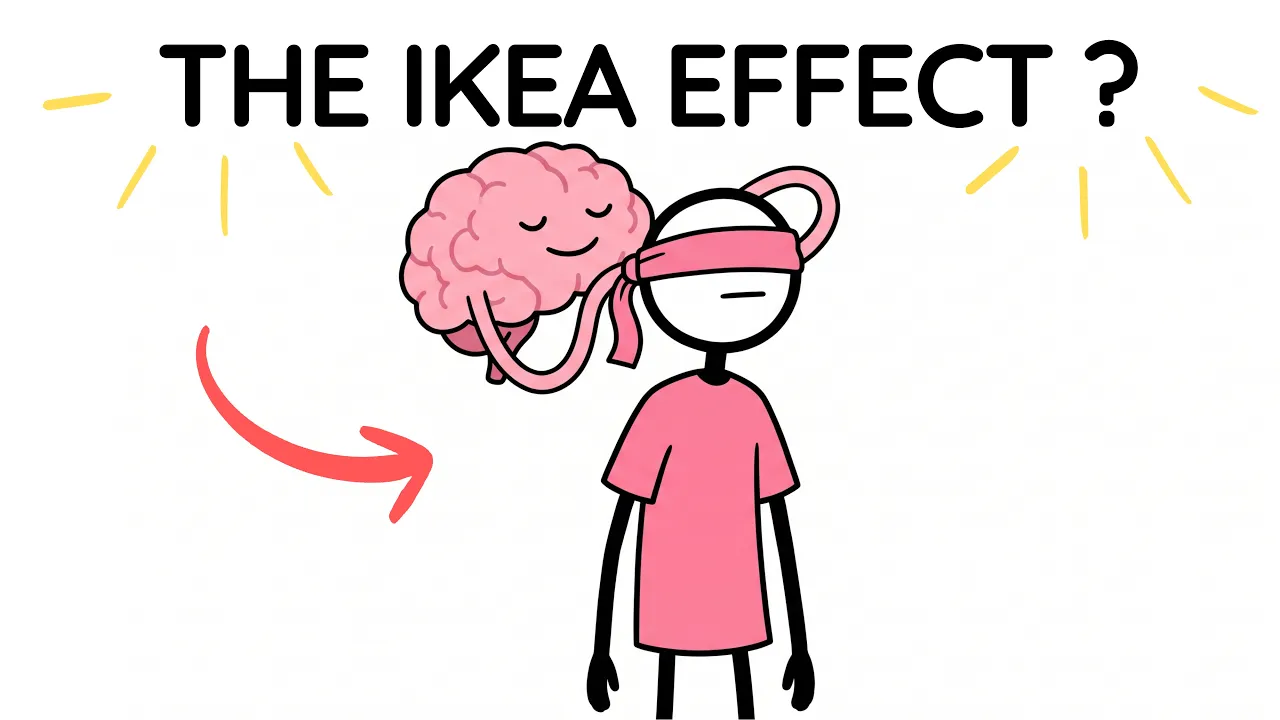
what is The IKEA Effect. transcript
Ink Explainer · @Inkexplainer96
Words
764
Runtime
4:09
Speaking pace
184wpm
Reading time
3min
184 words per minute, just over the 181 median of 349 measured videos. That distribution comes from the 349-video hook study.
Opening (first 30 seconds)
You've built something. Maybe it was a bookshelf. Maybe it was a terrible bookshelf with wobbly legs, one screw left over that you still can't explain. And yet the moment it was done, you looked at it and thought, "That's actually pretty good." That feeling that you get has a name and it's quietly controlling more of your life than you realize. In 2011, three behavioral scientists ran a study. They gave one group of people an origami frog to look at. They gave another group the paper and instructions to fold
92 words, the words spoken in the first 30 seconds at 184 words per minute.
Sentence shape
| Measure | This transcript |
|---|---|
| Sentences | 71 |
| Average words per sentence | 10.8 |
| Longest sentence | 32 words |
| Questions asked | 0 |
| Sentences containing a number | 4 |
Most used terms
- effort8
- brain6
- built6
- ikea6
- people6
- bookshelf5
- group5
- effect4
- ikea effect4
- love4
- better3
- build3
Filler phrases
2 in total: actually 1 · like 1.
A literal whole-word count of the same phrase list the Prepublish browser extension uses, so a phrase inside another word is not counted and a phrase used in its ordinary sense still is. It is a count and not a judgement.
What this transcript is
Every word below is the caption track YouTube publishes for this video, pulled from the video itself and reproduced unchanged. It is not Prepublish's writing, not a summary, and not a re-transcription: it is the video's own published captions. English captions, generated automatically by YouTube, in the video’s original language. Source: the video on YouTube. A channel that would rather this page did not exist can ask for its removal through the contact page, and it is removed.
Transcript
You've built something. Maybe it was a bookshelf. Maybe it was a terrible bookshelf with wobbly legs, one screw left over that you still can't explain. And yet the moment it was done, you looked at it and thought, "That's actually pretty good." That feeling that you get has a name and it's quietly controlling more of your life than you realize. In 2011, three behavioral scientists ran a study. They gave one group of people an origami frog to look at.
They gave another group the paper and instructions to fold one themselves. Then they asked both groups how much they'd pay for it. The people who built it valued it almost five times higher. Same frog, same paper, completely different price in their heads. They called it the IKEA effect. The more effort you put into something, the more you love it. Not because it's better, it's because you made it. Here's why this happens.
Your brain doesn't just track what things are worth. It tracks what things cost you. Time, effort, frustration, focus. Your brain treats all of that as investment. And once you've invested, your mind does something automatic. It starts protecting that investment. It inflates the value of what you made to justify the effort you spent. Just like this video. I made this myself for you. To anyone else, it's just another random video on the internet.
But because I invested my time, my energy, my frustration into it, it means something different to me. I can't see it the way you see it. That's just the IKEA effect running silently in the background. Psychologists call this effort justification, and it runs deep. In the 1950s, researcher Elliot Aronson found that people who went through a difficult initiation to join a group rated that group as significantly more valuable than people who joined it easily.
Nothing about the group changed, only the cost of getting in. Your brain genuinely cannot separate effort from worth. The harder something was, the better it must be. That's not logic. That's just how we're wired. And it's everywhere once you see it. The student who spends three weeks writing a thesis believes it more deeply than one they wrote overnight. The entrepreneur who sacrifices for two years to build a company can't see its flaws clearly.
The parent who struggles through a difficult first year with a child forms a bond so fierce, it borders on irrational. None of that is a mistake. That's the IKEA effect doing exactly what it was built to do. Because here's the thing, for most of human history, you had to make everything yourself. Your food, your shelter, your tools, your clothes. If you made something badly, you didn't romanticize it. You fixed it or you died.
The effort you put in was directly tied to your survival. So your brain evolved to reward that effort with attachment, with pride, with a value signal that said, "Protect this. You worked for it." The problem is, we live in 2025. You don't need to make anything anymore. Everything comes assembled, delivered, instant. But your brain hasn't updated. It still runs that old code. So when you finally do build something with your hands, even a flat-pack bookshelf with a missing dowel, the ancient reward system fires.
And it doesn't care that IKEA did 90% of the work. You held the Allen key. That's enough. But the IKEA effect has a shadow side. Because the same mechanism that makes you love what you build also makes you blind to its flaws. The researchers found that people who built their origami frog rated it just as highly as professionally made origami, even when it was objectively worse. Effort doesn't just inflate value, it switches off your critical eye.
This is why founders can't kill bad products. Why people stay in relationships they built from something broken. Why governments pour money into failing projects they already spent billions on. You don't just love the thing, you love the version of yourself that made it. There's a reason IKEA doesn't fully assemble their furniture before shipping it. It's not just cheaper, it's smarter. They're selling you something more valuable than a bookshelf.
They're selling you the feeling of having built it. And the moment you tighten that last bolt and step back, that wobbly, slightly uneven bookshelf becomes yours in a way that no store-bought shelf ever could. Not because it's better, because part of you is in it now, and your brain will never let you see it clearly again.
The words are the caption track's own and nothing is reworded or re-transcribed. Paragraph breaks are placed between sentences so the text reads as prose.
Use this transcript
Three free tools that work on the material around a video like this one. No signup, no login.
Hook Analyzer
Paste the first 30 seconds of your own draft for a hook score and rewrites.
Policy Pre-Flight
Check your draft against YouTube's advertiser-friendly guidelines before you record it.
Channel Skill Generator
Read this channel's public videos and transcripts, and download a writing brief for it.